Azazello
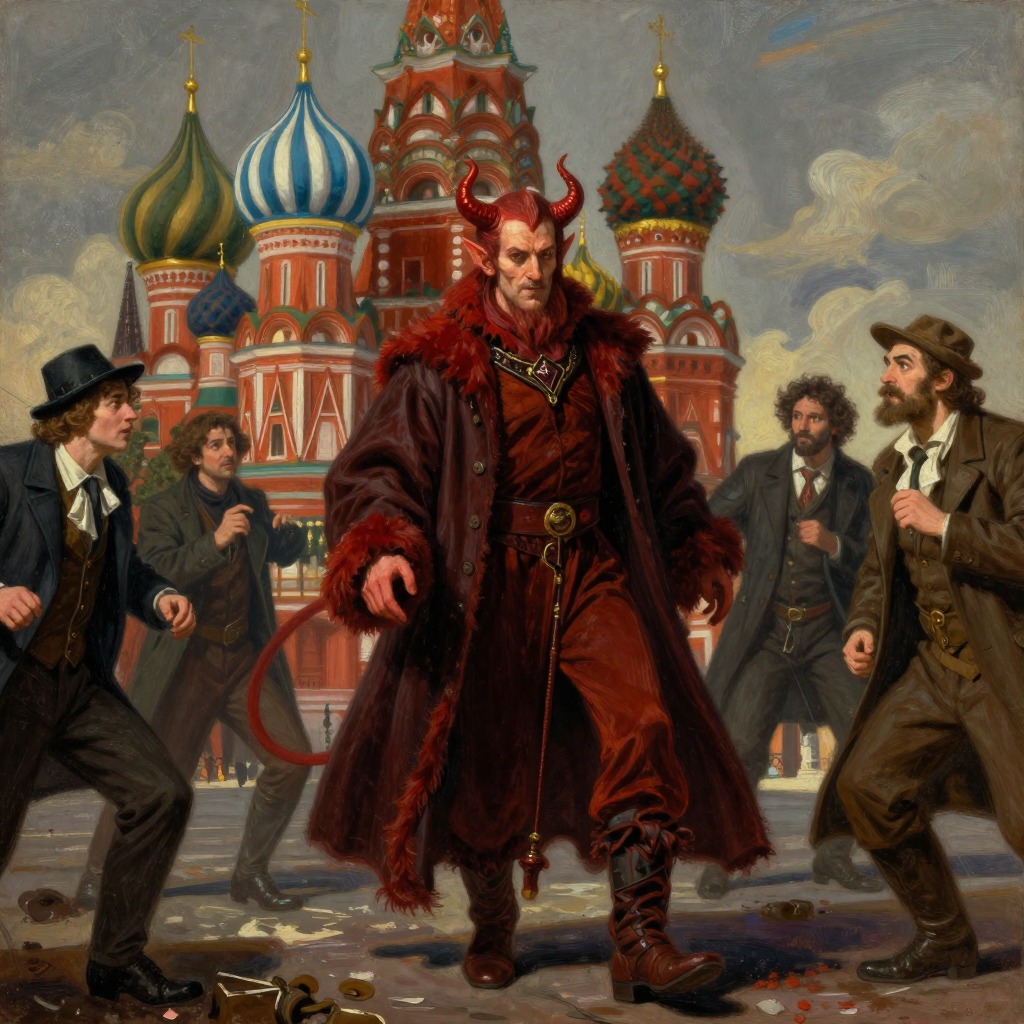
Azazello is a short but extraordinarily broad-shouldered member of Woland's demonic retinue, distinguished by his flaming red hair, a fang protruding from his mouth, and a physiognomy of unprecedented loathsomeness. He appears in the novel as a figure of pure, unadorned violence, the one to whom the dirty work of expulsion and execution is delegated. His name and function evoke the scapegoat ritual of Azazel, and his role in the Moscow narrative is to be the blunt instrument of infernal justice, removing those whom Woland deems superfluous or corrupt.
Identity and Appearance
Azazello is first introduced in the bedroom of Stepan Likhodeev, the director of the Variety Theatre, where he steps directly out of a pier-glass mirror. He is described as short but extraordinarily broad-shouldered, with a bowler hat on his head and a fang sticking out of his mouth, which makes an already unprecedentedly loathsome physiognomy still uglier. His hair is flaming red, and his voice has a nasal twang. When he speaks, his nasal twang grows stronger and stronger. He is the fourth and last appearance in the apartment, materializing after the long checkered one and the black cat Behemoth have already presented themselves. His sudden emergence from the mirror, combined with his grotesque appearance, marks him as a being of a different order from the other demons—less a trickster than a thug.
Role as Enforcer and Executioner
Azazello's primary function within Woland's retinue is that of enforcer and executioner. When Woland observes that Stepan Likhodeev is the one too many in the apartment, Azazello immediately requests permission to "chuck him the devil out of Moscow." He is the one who physically assaults the administrator Ivan Savelyevich Varenukha, striking him on the ear and later, together with a cat-like accomplice, dragging the half-alive administrator through the storm to Apartment No. 50. His violence is direct and brutal, lacking the theatrical flourishes of Koroviev or the playful sadism of Behemoth. He is also associated with the figure of Abaddon, the angel of the abyss, whose work Woland describes as "impeccable" and who sympathizes equally with both sides of a fight, ensuring the results are always the same for both sides. This connection underscores Azazello's role as an agent of impartial, mechanical destruction.
Relationship with Woland and the Retinue
Azazello is deferential to Woland, addressing him as "Messire" and seeking his permission before acting. He is the most direct and least playful of the retinue, contrasting sharply with the chatter of Koroviev and the antics of Behemoth. When Behemoth observes that Azazello does not look like a bishop, Azazello simply replies, "That's what I mean," and turns to Woland for orders. His relationship with the other demons is one of functional coexistence rather than camaraderie; he is the heavy, the one who does the work that requires no words. His presence in the retinue completes the spectrum of infernal power: Woland is the sovereign, Koroviev the jester and diplomat, Behemoth the clown and glutton, and Azazello the executioner.
Narrative Significance and Thematic Resonance
Azazello embodies the novel's theme of merciless, impersonal justice. He is the force that removes the corrupt and the superfluous without ceremony or sentiment. His violence is not personal but functional, a necessary part of the cosmic order that Woland administers. In a world where cowardice is the most terrible of vices, Azazello represents the opposite: a being without fear, without hesitation, and without mercy. He is the demon who does not argue, does not explain, and does not forgive. His presence in the novel serves as a reminder that the power that eternally wills evil and eternally works good has many instruments, and that some of them are as blunt and final as a blow to the head.